GSD's GCF Repo Netting and Settlement services facilitate efficient settlement and risk management for the GCF Repo® Service. Scroll down and/or expand a topic to learn about Netting & Settlement for the GCF Repo Service.
Netting
GCF Repo Transactions are submitted to the GSD RTTM® Web application by GCF-Authorized Inter-Dealer Brokers throughout the day and are affirmed by the GCF Counterparties. The deadline for GCF trade submissions and affirmations/cancellations, as applicable, is 3:00 P.M., per the Schedule of GCF Repo Timeframes in the GSD Rulebook. After the deadline, all unaffirmed GCF Repo Transactions will be automatically affirmed by the system as part of the GCF Netting process. All affirmed GCF Repo Transactions from the current day along with carry-over activity, including previous term and previously submitted forward-starting activity that has reached its start leg settlement date, are totaled and then netted on a multi-lateral basis to create a single GCF Net Settlement Position, either a Collateral Allocation Obligation or a Collateral Allocation Entitlement for each Member per GCF Repo Generic CUSIP Number. Once the netting process has completed, GSD reports the netting output to GSD’s GCF Clearing Agent Bank(s) and participating Members. The output provided by GSD to the clearing bank(s) is used to create Tri-Party shells within GSD’s GCF Clearing Agent Bank’s Tri-Party mechanism(s) to facilitate the settlement of the underlying securities allocated to GCF shells versus the principal value for their Members.
Let’s look at an example of the netting of GCF Repo Transactions.
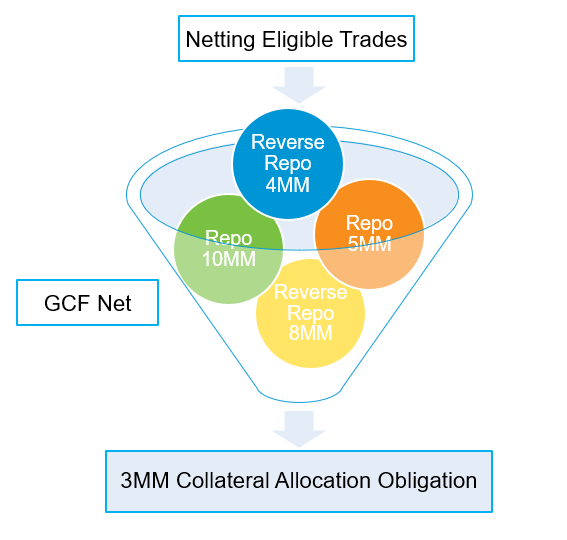
In this example, a Member has four (4) GCF Repo Transactions in the same GCF Repo Generic CUSIP Number eligible for settlement that day. Two (2) are Repo Transactions totaling 15 Million in Start Money and two (2) are reverse repo transactions totaling 12 Million in Start Money. The repo and reverse repo transactions are netted down to create a single GCF Net Settlement Position that results in a Collateral Allocation Obligation of 3 Million in that GCF Repo Generic CUSIP Number.
Settlement occurs after GSD has informed its Netting Members as GCF Counterparties of their respective obligations, either a Collateral Allocation Obligation or Collateral Allocation Entitlement/cash obligation at the GCF Repo Generic CUSIP Number level. Settlement is facilitated by GSD’s GCF Clearing Agent Bank(s) through their Tri-party mechanism(s). The total repo interest accrued on overnight GCF Repo Transactions is settled through the Start of Day GCF Funds-Only Settlement (FOS) process the following business day, the End Leg Settlement Date. For term GCF Repo Transactions, interest is passed each day until the End Leg Settlement Date of the GCF Repo transactions. The total repo interest on GCF Repo Transactions is collected/paid through the GCF Transaction Adjustment Payment (TAP) component of GCF FOS.
Let’s look at an example of the settlement of GCF Repo Transactions.
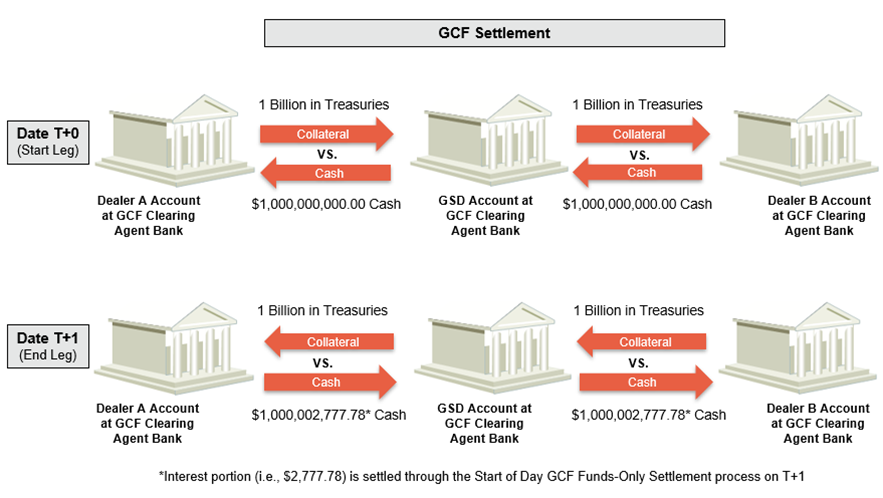
In this example, Dealer A and Dealer B have negotiated anonymously through an Inter-Dealer Broker (IDB). The trade is an overnight trade on a generic CUSIP representing Treasuries. The principal amount is 1 Billion. The rate is 10 basis points and there is no haircut.
Based on the transactions details in this example the following will occur:
On trade date, which for this example is also the submission date, the Inter-Dealer Broker submits the transaction details to GSD on a locked-in basis for settlement tomorrow. The trade novates and GSD becomes the legal counterparty to both Dealer A and Dealer B. Also on trade date, Dealer A sends 1 million in U.S. Treasuries to GSD in return for $1 billion in cash. GSD then sends the 1 billion in U.S. Treasuries to Dealer B in return for $1 billion in cash. On T+1 the following business day, the flows are reversed. The U.S. Treasuries are returned to Dealer A and the cash plus interest is returned to Dealer B, with GSD acting as intermediary settling the interest through the Start of Day Funds-Only Settlement process.
Alternatively, if in the above example there was additional GCF Repo activity (or CCIT activity) executed by Dealer A and/or Dealer B via a GCF-Authorized Inter-Dealer Broker where the Start Leg Settlement Date is T+1, on T+1 what would settle at the GCF Clearing Agent Bank(s) would be the net of the unwind of the previous day’s GCF Net Settlement Position and the current day’s GCF Net Settlement Position for each Member at the GCF Repo Generic CUSIP Number level. In other words, every Collateral Allocation Entitlement and Collateral Allocation Obligation that is created by GSD every Business Day will be netted on the next business day with that day’s Collateral Allocation Entitlement and/or Collateral Allocation Obligation, which is referred to as GCF net-of-net settlement.
Following the same scenario as above, let’s take a look at an additional example in which on T+1 Dealer A and Dealer B execute an additional GCF Repo transaction in the same GCF Repo Generic CUSIP Number as the previous example through a GCF-Authorized Inter-Dealer Broker, whereby Dealer A is the repo party and Dealer B the reverse repo party to a $500 million overnight GCF Repo transaction at a rate of 0.10% due to start on T+1.
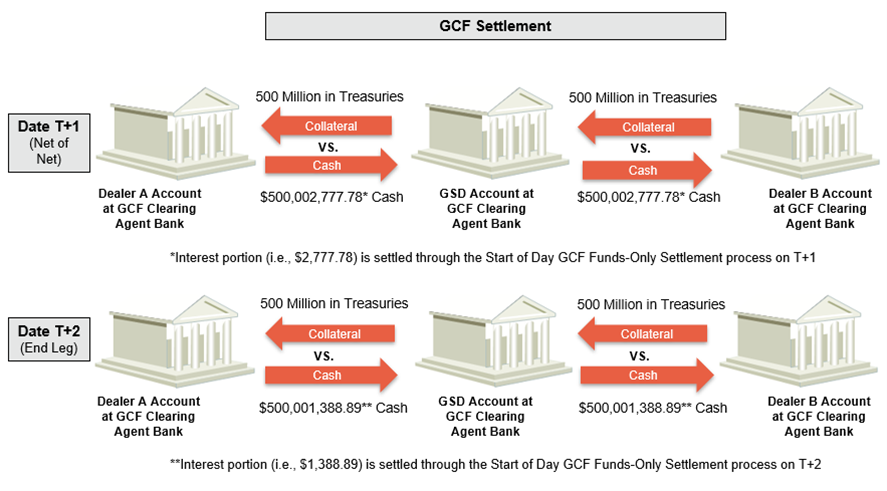
On T+1 Dealer A’s previous day (T+0) Collateral Allocation Obligation was for 1 billion in U.S. Treasury collateral, while Dealer B’s previous day (T+0) Collateral Allocation Entitlement was 1 billion in U.S. Treasury collateral. On T+1 the previous day obligations would be unwinding, while for current day Dealer A has a Collateral Allocation Obligation of 500 Million in Treasury collateral and Dealer B has a Collateral Allocation Entitlement of 500 Million in Treasury collateral. Assuming no other GCF trade activity for Dealer A and Dealer B and based on the two transaction’s details in this example, the following settlement flow will occur post the GCF netting process on T+1:
GCF net-of-net settlement on T+1 would result in a Collateral Allocation Entitlement of 500 Million in Treasury collateral for Dealer A, while Dealer B would have a Collateral Allocation Obligation of 500 Million in Treasury collateral. Dealer B fulfills their Collateral Allocation Obligation by allocating 500 Million in U.S. Treasuries at GSD’s GCF Clearing Agent Bank. The collateral is then onward allocated by GSD’s GCF Clearing Agent Bank to Dealer A through its’ Tri-Party mechanism. Dealer A fulfills their Collateral Allocation Entitlement by funding $500 Million in cash. The cash is then forwarded on by GSD’s GCF Clearing Agent Bank to Dealer B through its’ Tri-Party mechanism. The interest accrued overnight on the GCF Repo Transaction executed on T+0 and ending on T+1 is passed from Dealer A to Dealer B through the Start of Day GCF Funds-Only Settlement process, with GSD acting as intermediary. This completes settlement on T+1 in this example.
On T+2, the GCF netting process will establish a Collateral Allocation Obligation for Dealer B and Collateral Allocation Entitlement for Dealer A to settle the End Leg of the remaining GCF Repo Transaction. To settle the End Leg, Dealer A funds $500 million in cash at GSD’s GCF Clearing Agent Bank. Through the GCF Clearing Agent Bank’s Tri-Party mechanism, an unwind is performed whereby the cash is then forwarded on to Dealer B and the 500 Million in U.S. Treasury collateral is returned to Dealer A, fulfilling both Dealer A and Dealer B’s obligations. The interest accrued overnight on the GCF Repo Transaction executed on T+1 and ending on T+2 is passed from Dealer A to Dealer B through the Start of Day GCF Funds-Only Settlement process, with GSD acting as intermediary. This completes settlement of the End Leg in this example.