Tokenization Service: Account Screen
The Account screen displays the structure of your associated accounts. DTCC Participants are granted access to the Tokenization UI through the onboarding process. Once access is enabled, use this screen to:
- Manage your Classic and Digital (Client and Internal) accounts.
- View account activity including transfers, transfer types, and the associated securities and quantities.
- View the balance for each account and its record for each security position in the relevant blockchain network.
- Export account data from an account, including securities credited to the DTC Participant's account that may be subject to a Tokenization Instruction, and download the data as a CSV file.
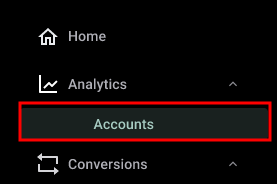
The Account screen is located within the Analytics section of the left-hand navigation.
Account Structure
The Tokenization Service automatically creates two accounts—or account buckets—for participants. These accounts are listed in the Structure tab.
- The Classic Account represents the traditional DTC participant account.
- The Digital Account represents accounts associated with blockchain-based wallets.
Note
While the Classic Account displays two wallets, FreeMA and FreeNA, this distinction has no impact on executing conversion orders. The Conversion Order dialog box displays only a single Free account, and ATP debits the position from either the NA or MA account based on the available balance in each account. 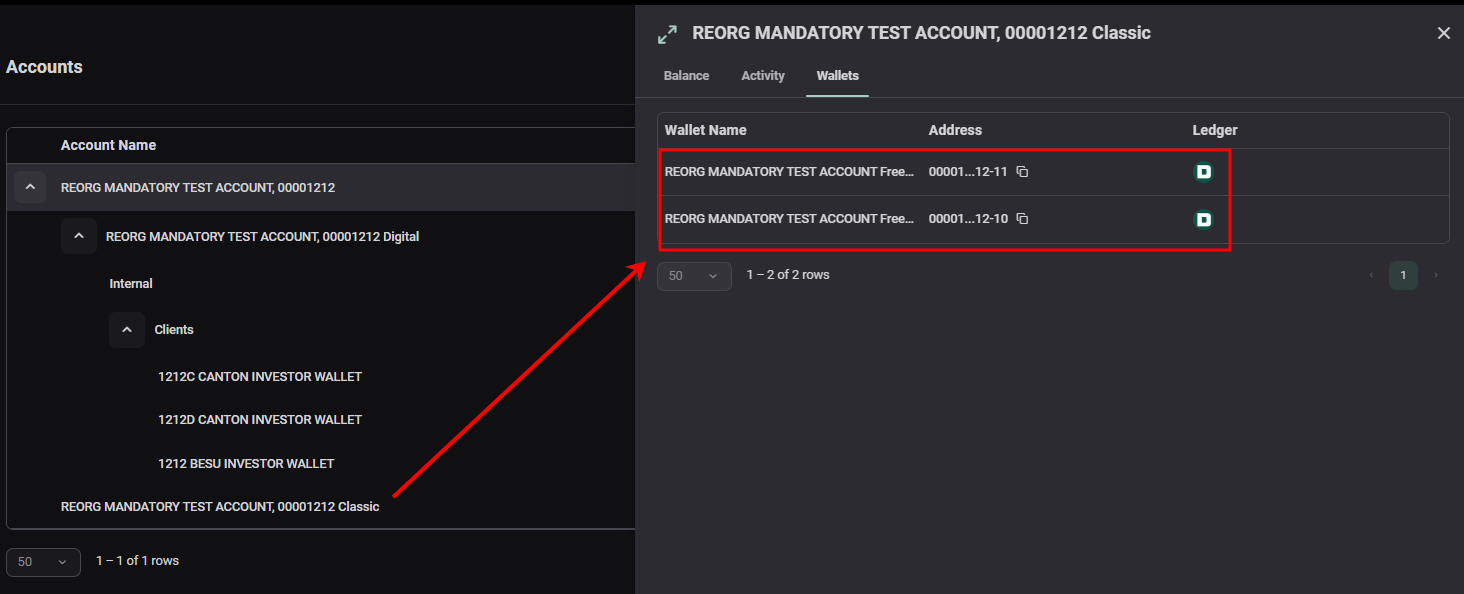
There are two sub-accounts within the Digital Account:
- Client Accounts contain client-specific sub-ledger wallets for participants acting as custodians, primer brokers, or other roles for their own clients where they are tracking their books and ledgers.
- Internal Accounts are wallets owned and established by participants based on their organizational needs.
Key Concept
- Digital accounts are essentially containers, or “buckets,” that participants can use to organize their digital assets according to their preferences. This flexibility enables the movement of assets between wallets based on organizational requirements or specific tokenization use cases.
- All new digital accounts are created through the Register Wallets screen.
To view the entire account structure, including its Classic and Digital wallets, click Expand All located to the right of the Account Name field.

|
This action displays all account categories, including Digital (Clients and Internal) and Classic.
|
|
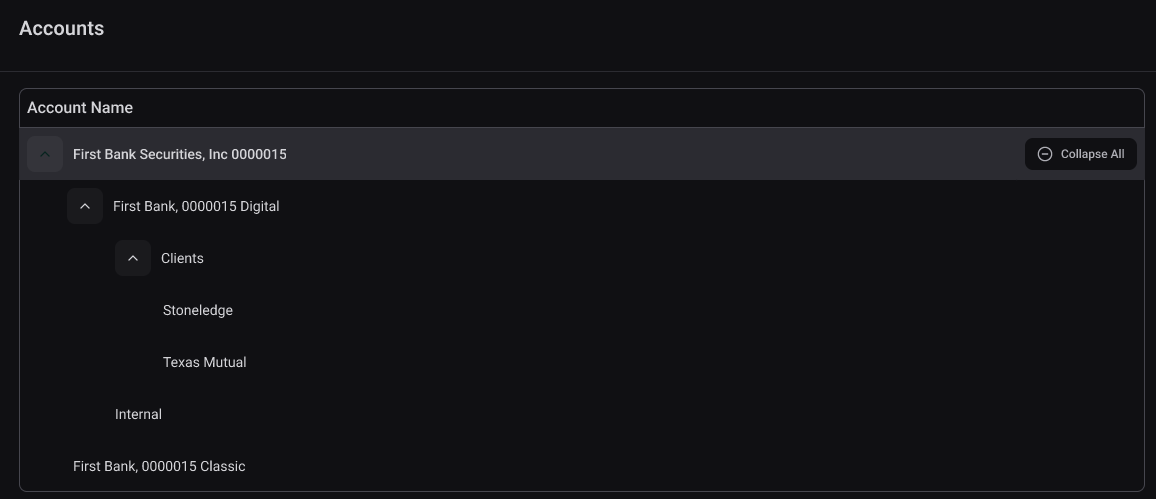
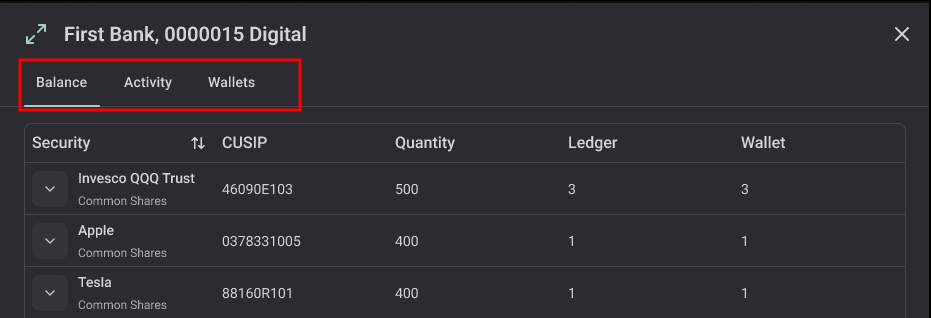
Select an account category to view additional details. The following tabs are available for each account category:
|
|
|
Important |
|
You can only view details for the account category selected. For example, if you select an Internal Account, only the Balance, Activity, and Wallets information for that specific sub-account will be displayed. |
Balance Tab
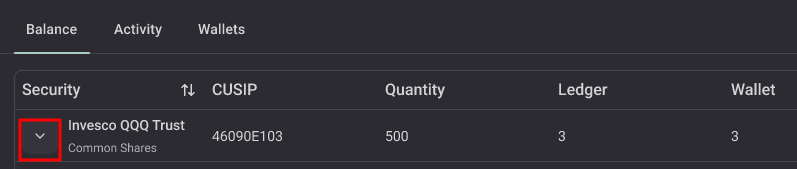
The Balance tab displays all token balances for securities associated with the selected account.
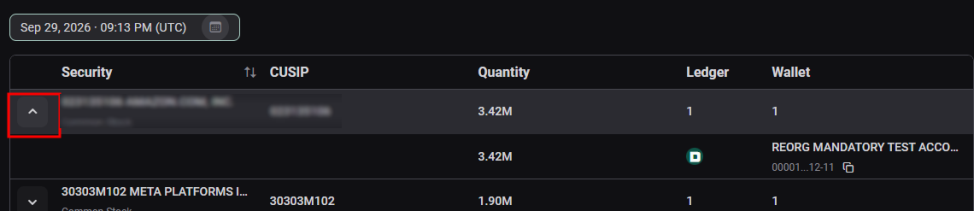
Use the directional caret to view a detailed breakdown of quantities across multiple wallets and ledgers.
|
|
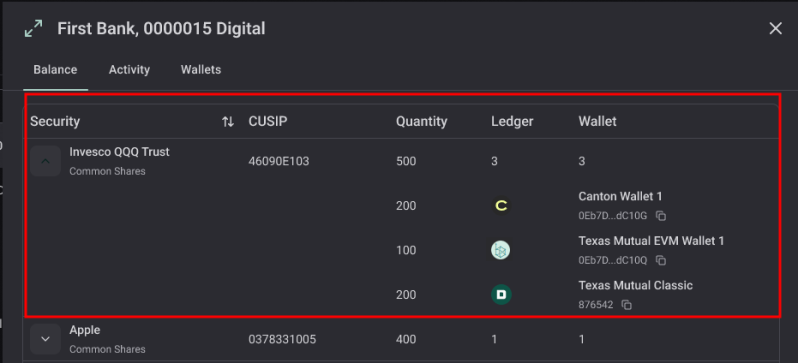
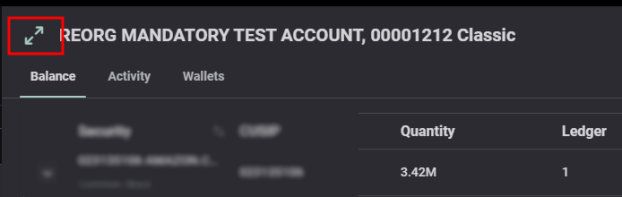
You can search and download account data by clicking the Expander icon  . For instructions on downloading a CSV file of account data, see Export Account Data.
Activity Tab
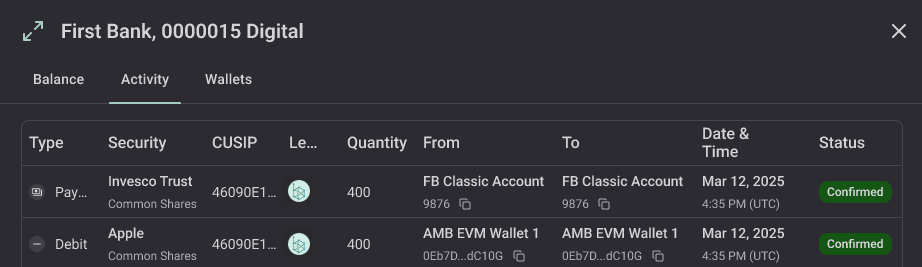
The Activity tab displays all activities (transactions) associated with the selected account or wallet.
|
|
| Note |
| Classic account transactions that are not associated with digital account movements (for example, transfers between two classic accounts) will not appear in the Activity tab. The Activity tab displays digital account transactions and on-chain activity only. |
The following table describes the columns on the Activities tab:
| Field | Description |
|---|---|
| Type |
The transaction type, for example, Payment Received, Payment, freeze,or unfreeze. |
| Security | The Security associated with the transaction. |
| CUSIP | The CUSIP associated with the security. |
| Ledger |
The ledger associated with the transaction. Note: This field is denoted by the ledger’s associated blockchain icon.
|
| Quantity | The quantity of tokens, or shares, associated with the transaction. Note: each token represents a share and the platform does not allow fractional tokens. |
| From | The participant account or wallet sending the tokens in the transaction. |
| To | The participant account or wallet receiving the tokens in the transaction. |
| Date & Time | The timestamp of the most recent status update for the transaction. |
| Status |
The status of the transaction, specifically, whether or not it is Confirmed. |
 icon refers to the
  icon refers to
  icon refers to DTCC's offchain ledger that is tied to the participant's DTC account.
 Wallets Tab
The Wallets tab provides a list of all wallets associated with the selected account, including wallet addresses and their corresponding ledgers.
|
|
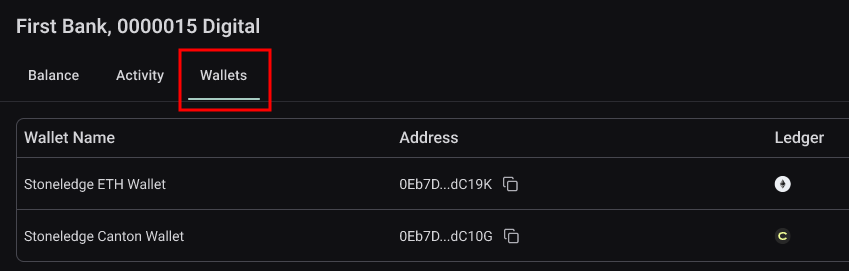
Use the copy icon in the Address field to copy a wallet address.
|
|

|
Key Concept |
|
The Wallets tab provides a summary of all wallets associated with an account. The Balance tab provides a detailed view of which wallets hold specific securities. |
Search and Export Account Data
You can export account data, including Balance, Activity, and Wallets, and download as a .csv file.
Click the account whose data you want to export, for example, the Classic account.
|
|
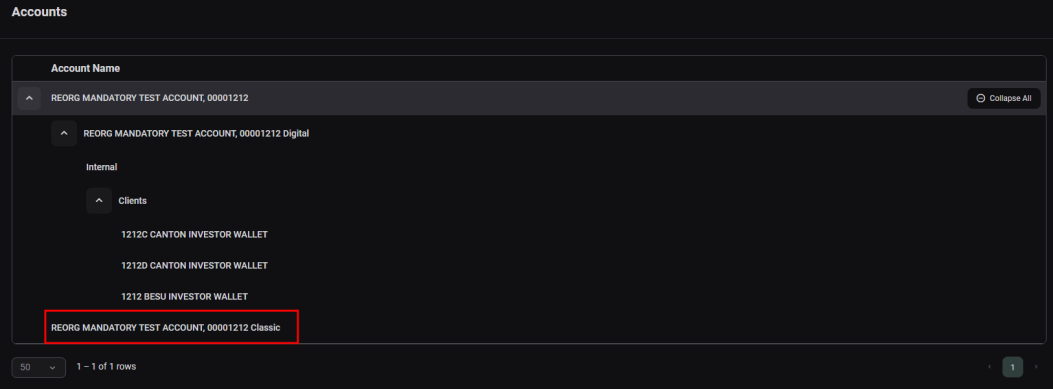
Click the Expander icon in the upper-left corner of the data view.
|
|
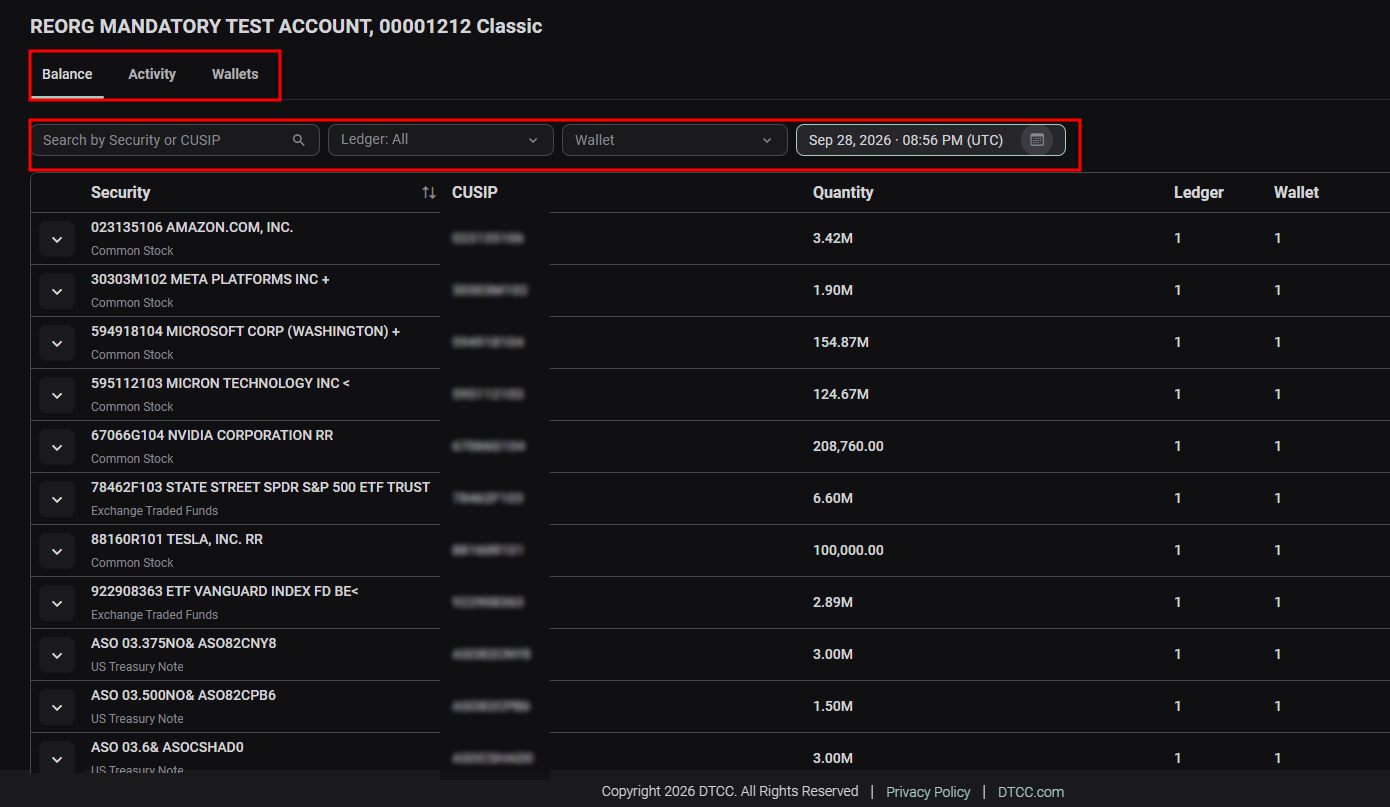
The account details display in a full-screen view. From here, you can access all account tabs: Balance, Activity, and Wallets.
Use the search filters at the top of the screen to refine the displayed data.
|
|
For the Balance tab, use the directional caret to view a breakdown of the security holdings across wallets.
|
|
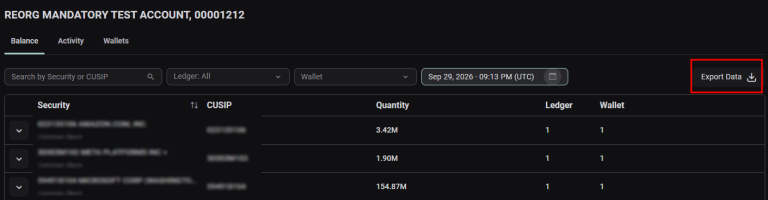
To download the displayed data, click Export Data above the data set on the right side of the screen. Note: For the Balance tab, the exported data includes all holdings across all wallets, regardless of whether the security has been expanded on the screen.
|
|
|
Important |
|
Any search filters applied to the data will affect the exported file. For example, if you filter by a specific CUSIP and then click Export Data, the downloaded CSV file will contain only data for that CUSIP. |